2087–2100
Solar evolution
Sunlight became the foundation of a closed economy, and its limits pushed engineers to build upward.
Solar energy had been widely used before the Year of Exhaustion, but after 2087 its role changed fundamentally. It was no longer one energy source among many. It became the foundation on which humanity would try to rebuild its civilization. Solar technology was redesigned for durability and material recovery, so old panels could be taken apart and their glass, metals and silicon returned to production. Every gain in efficiency meant the same limited material could generate more energy. Solar became one of the few systems that could still grow without depending heavily on newly extracted resources.
Slowly, the direction became clear. If materials could no longer be replaced, they would have to circulate. If energy could no longer come from resources stored beneath the Earth, it would have to come from the energy constantly reaching it from above.
Humanity began turning its economy into an ever more closed system. Materials were recovered, processed and reused again and again, while sunlight provided the energy that kept the cycle moving. Large population centers became easier to maintain than the sprawling suburbs, roads and small settlements of the previous century. Maintaining infrastructure across enormous distances consumed materials civilization could no longer afford to lose.
The improved solar systems stabilized society for a while, but they came with a limit: surface area. People crowded around the remaining industrial centers, land grew ever more valuable, and large solar installations competed with housing, agriculture and infrastructure for space. Society could not afford to spread outward again, and sunlight decided how much energy a city could produce. It needed a different solution.
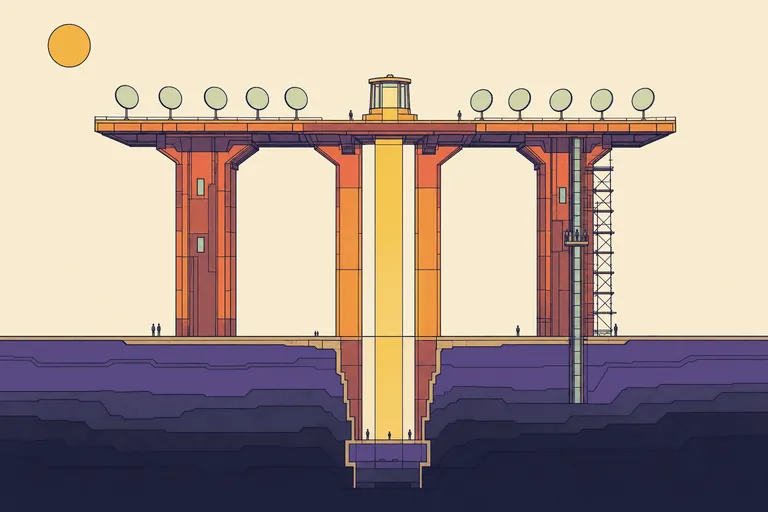
Engineers had only a finite area to work with, but a single idea could overcome that limit. They would build upward. The first plans took shape over the following years. Instead of raising entire cities into the sky at once, engineers proposed massive structural pillars that could carry energy systems, transport, housing and future expansion. The pillars were designed to grow over time, so new platforms and infrastructure could be added as society's needs increased.
At the same time, humanity began to see the Sun differently. It was no longer only a source of energy, but the one resource that had remained while almost everything else had become scarce. For many, sunlight became a symbol of survival, of renewal, and of the hope that humanity could still correct the mistakes of the past.